"We do not deal in personal loan/ Business Loan/ Investment plans, neither we have any subsidiary company dealing in such products. Be careful of fraudsters "

The Limitations to Remittance and ways to overcome it

remittance-limitations

The pandemic has affected many parts of the economy, with most of them moving forward in recovery mode now. Remittance has served as one of the affected industries and in this article, we focus on the limitations imposed on it and the ways to overcome them. Most countries rely on migrant workers, defined as someone who has migrated from their home country or country or another country for employment. Migrant workers can be found in nearly every country in the world. Remittances are funds transferred from migrants to their home country. They are the private savings of workers and families that are spent in the home country for food and other expenses which drive the home economy. Many developing countries may need more assistance in managing their remittances. Remittances give countries the ability to fund development in their own way and learn how to effectively use remittance funds (Investopedia).

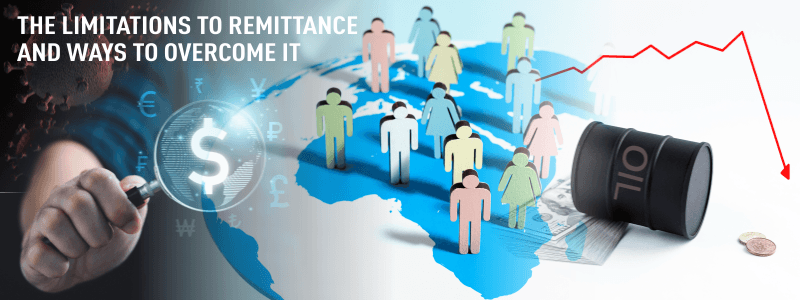
While remittances are an important lifeline in many developing countries, they can also foster a dependency on outside flows of capital instead of prompting developing countries to create sustainable, local economies (Investopedia). As for East Asia and Pacific regions, the remittance flows in their region grew by around 2.6 percent to $147 billion in the year 2019. However, this growth was lower than in 2018 by 4. 3 percent points. In the year 2020, this flow is expected to decline by around 13 percent. The major reason for the drop is the decline in remittance inflows from the United States which is the largest source of remittances in the region. As for the South Asia region, the main cause of the remittance decline in the South Asia region is the global economic crisis led by Covid -19 pandemic. The oil price declines have also contributed to the decline of the remittances to this region. The economic slowdown will also affect the remittance outflows from the countries like the United Kingdom, The United States, Europe, and South Asia. Moreover, declining oil prices will cause a fall in remittance outflows from Malaysia and Gulf Cooperation Council (GCC) countries.

Furthermore, there are a few challenges faced by remittance providers around the globe. We are about to take a closer look at them here. According to a survey conducted by the International Association of Money Transfer Network (IAMTN) in collaboration with the United Nations Capital Development Fund (UNCDF) around 91 percent of the 75 plus remittance service providers participants from more than 30 countries said that they had experienced notable changes in the overall remittance volumes. As remittance volume is declining, the operational costs for remittance service providers are rapidly translating into losses. A sudden decrease in remittances due to lockdown, loss of employment as well as repatriation to the home countries. At the same time, remittance service providers incur costs such as rentals, building maintenance, operating expenses, and salary payments. The decrease in revenue is not helping remittance companies maintain their livelihoods.

However, these limitations can be overcome in a few ways. Firstly, remittance service providers can adopt FinTech solutions . To ensure the success of digital channels, they must work with public institutions to increase the adoption of FinTech services for both senders and receivers; reaching people in both host and home countries to bring awareness about digital solutions by promoting them. The service providers should also have a more user-friendly as well as efficient platform to increase the volume of customers. Secondly, it is important to create a conducive remittance policy. For a good example, here at Lotus Remit, our services are provided using FinTech which is both efficient and user-friendly; one of the many reasons why customers love coming back to us. Moreover, during the current time, the services must be supported with a non-discriminatory legal and regulatory framework that can mitigate the remittance decline. Expand the usage of digital solutions and improve the formal channel for cross-border payments. Governments should offer concessional lines of credit to already struggling remittance providers. This will help ease their burden. Additionally, it is important to embrace digital solutions to help improve the situation. This is one of the best ways to cope with the post-pandemic situation.

In order to achieve that we must encourage the use of digital solutions to broaden the spectrum of digital financial channels (digipay.guru). Lotus Remit is one of the remittance service providers that have best understood the need to embrace digital solutions in the remittance industry. Even though we have a physical company to run our operations, our services are provided online with the aid of digital channels. This has been able to keep us at par with the growing technology and assist clients in the best possible way according to their needs.

In conclusion, there are many limitations and challenges imposed on remittances, especially during times of economic recovery post-pandemic and other economical hits. However, there are a few ways they can be overcome by remittance service providers as well as the government to improve this situation. Remittance serves as an important service to migrant workers and their home economies by contributing to their economies financially. Hence, it is rather important to keep remittances flowing since it is an important contributor to low and middle-income economies alike, improving the state and livelihood of both economies with their services.